The 10 Best Roofing Nailers
Updated by · How we research

Ten coil roofing nailers, air and cordless, compared by trigger, depth control, warranty and weight. The Bostitch RN46-1 leads: light, proven, seven-year warranty. When users buy our independently chosen editorial recommendations, we may earn commissions to help fund the Wiki.
Most roofers still use an air-powered coil nailer: it's lighter than a battery model, cheaper to run and has less to break. Battery guns earn their place on small jobs and repairs, where hauling a hose and compressor up a ladder isn't worth it. This list covers both, for pro crews and homeowners shingling their own garage or shed.


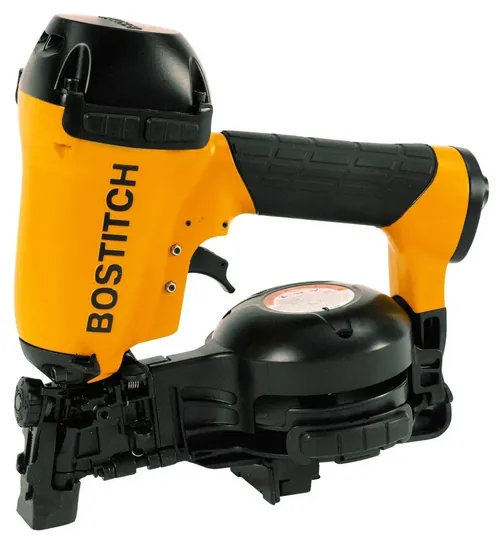
From the manual
- Set the coil platform for the nail length before loading: top step for 3/4 to 1-1/4 inch nails, bottom step for 1-1/2 and 1-3/4. p. 6
- Use Bostitch air tool oil or a plain equivalent; detergent oils and additives wear out the seals and bumpers. p. 5
- Near freezing, moisture in the air line can freeze and stop the gun; Bostitch suggests a winter-formula lubricant. p. 5
- The seven-year warranty treats driver blades, bumpers, O-rings and pistons as wear parts, and production use gets one year. p. 2
Why the Bostitch RN46-1 is our top pick
Our pick is lighter and carries a longer warranty than our runner-up, the Metabo HPT NV45AB2: its maker lists it at 4.8 pounds against 5.7,1,2 and backs it for seven years against five.1,3 On a gun you hold over your knees all day, that difference adds up. The warranty has limits, though: driver blades, bumpers, O-rings and pistons count as wear parts, and production use gets one year.1
Both guns ship as bump-fire tools. Single-shot firing on our pick means buying its twin, the RN46-2, at the same weight,1 while the runner-up takes a trip kit, part 878226, that its maker says can slow the gun down.2 Our pick drives nails from 3/4 inch; the runner-up starts at 7/8 inch and needs 16-degree coils.1,3 Our pick also has a zero-nail lockout that stops dry firing,4 while the runner-up's own manual warns that its last nail can drop out or go in crooked.2
The runner-up has real strengths. Its maker rates it at up to 10 nails a second, fits rubber pads to keep it from sliding down the roof, and says Builder and Developer magazine named it the Pro Preferred nailer every year from 2014 to 2025.3 If raw speed matters more to you than weight and warranty, it is the better buy.
| Bostitch RN46-1 | Metabo HPT NV45AB2 | |
|---|---|---|
| Weight, tool only | 4.8 lb | 5.7 lb |
| Warranty | 7 years (1 in production use) | 5 years |
| Single-shot firing | Separate model, the RN46-2 | Trip kit 878226, sold separately |
| Nail lengths | 3/4 to 1-3/4 in. | 7/8 to 1-3/4 in., 16-degree coils |
| Maker speed claim | Not stated | Up to 10 nails a second |
Sources
- Bostitch RN46-1 1Operation and maintenance manual (PDF), pp. 2, 4
- Metabo HPT NV45AB2 2Instruction and safety manual (PDF), pp. 10, 15–16, 15 3Product page
- 4JobNimbus: best roofing nailers
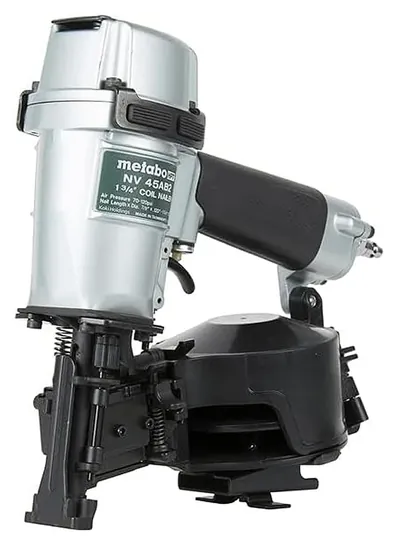
From the manual
- It ships as a bump-fire gun; single-shot firing needs trip kit 878226, which Metabo HPT says can slow the gun down. pp. 15-16
- The depth adjuster clicks at every quarter turn, and each click moves it about 0.25 mm. p. 17
- After the job, put 5 to 10 drops of tool oil in the air plug and drain the compressor tank. p. 16
- Metabo HPT warns that the last nail in a coil can drop out or go in at an angle. p. 15
Compare the specs
Swipe the table sideways to see every column.
| Product | Power | Trigger as shipped | Weight, tool only (lb) | Warranty (years) |
|---|---|---|---|---|
| 1. Bostitch RN46-1 | Air, 70-120 psi | Bump; single-shot is RN46-2 | 4.8 | 7 (1 in production use) |
| 2. Metabo HPT NV45AB2 | Air, 70-120 psi | Bump; single-shot kit extra | 5.7 | 5 |
| 3. Milwaukee M18 FUEL 2909-20 | M18 battery, sold separately | Switch: single or bump | 7.3 | 3 |
| 4. Max SuperRoofer CN445R3 | Air, 70-100 psi | Bump; single-shot kit extra | 5.6 | 5 |
| 5. Makita AN454 | Air, 70-120 psi | Switch: single or bump | 5.2 | 3 |
| 6. DeWalt DCN45RND1 | 20V battery, 2 Ah in kit | Bump only | 6.8 | 3 (battery 2) |
| 7. Bostitch BRN175A | Air, 70-120 psi | Contact trigger | 5.3 | 7 (1 in production use) |
| 8. Metabo HPT NV1845DA | 18V battery, 2 Ah in kit | Switch; starts in single | 8.6 | Lifetime body, battery 2 |
| 9. Freeman G2CN45 | Air, 70-115 psi | Switch: single or bump | 4.45 | 7 (not production use) |
| 10. WEN 61783 | Air, 70-120 psi | Two triggers in the box | 5.95 | — |
Weights are for the bare tool, without a battery or nails. WEN's product page lists a one-year warranty and its manual two years (90 days for professional use), so that cell is left blank.
Sources
- Bostitch RN46 operation and maintenance manual (PDF) BRN175A instruction manual (PDF)
- Metabo HPT NV45AB2 instruction manual (PDF) NV45AB2 product page NV1845DA instruction manual (PDF) NV1845DA product page
- Milwaukee 2909-20 product page 2909-20 operator's manual (ManualsLib copy)
- Max CN445R3 operating manual (PDF) Nailer warranty
- Makita AN454 instruction manual (PDF) Warranty
- DeWalt DCN45RN instruction manual (PDF) DCN45RND1 product page
- Freeman G2CN45 manual (PDF) G2CN45 product page
- WEN 61783 manual (PDF) 61783 product page
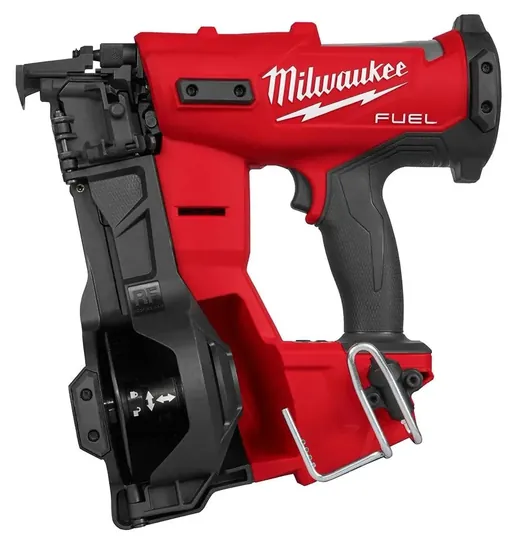
From the manual
- A button switches between single-shot and bump firing; Milwaukee asks for a function test before each day of work. pp. 6, 8
- With one nail or none left, the nose won't press in, so it can't fire blanks. p. 7
- It is rated for 0 to 125 F; near those limits it fires slower, and past them it stops until it warms or cools. pp. 3, 7
- Milwaukee asks you to send the tool, battery and charger in for inspection every six months to a year. p. 9
Milwaukee M18 FUEL 2909-20 operator's manual (ManualsLib copy)
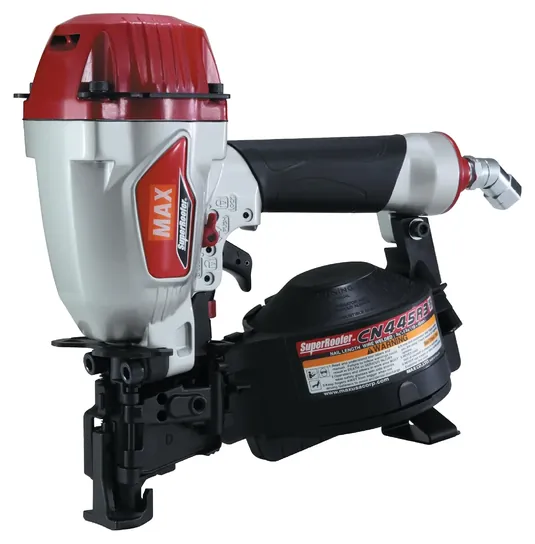
From the manual
- Rated for 70 to 100 psi, and Max says never to run it above 120 psi. p. 7
- Clean tar off the nose with kerosene or diesel, dipping only up to the nail heads, then dry it; leftover oil speeds new buildup. p. 10
- It ships with a black contact trigger; the single-shot trigger is an optional kit. p. 11
- Turn the trigger lock dial to its free position before nailing, and don't fire the gun empty. pp. 10, 12
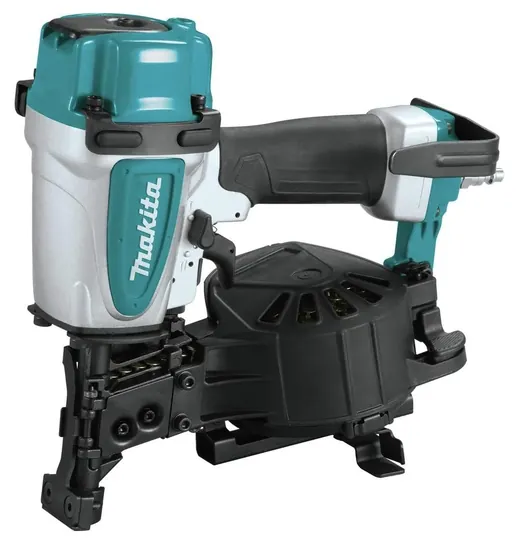
From the manual
- Don't hang it from a waist belt by its hook; Makita says a dropped nailer can misfire. p. 5
- In single-shot mode, pull the trigger fully and hold it a second or two: a half-pulled trigger can fire when the nose touches down again. p. 7
- With an in-line oiler, set one drop per 30 nails; without one, add two or three drops at the air fitting before and after use. p. 5
- The printed warranty says one year, but Makita's warranty page now gives pneumatic nailers three years. p. 10; Makita warranty page
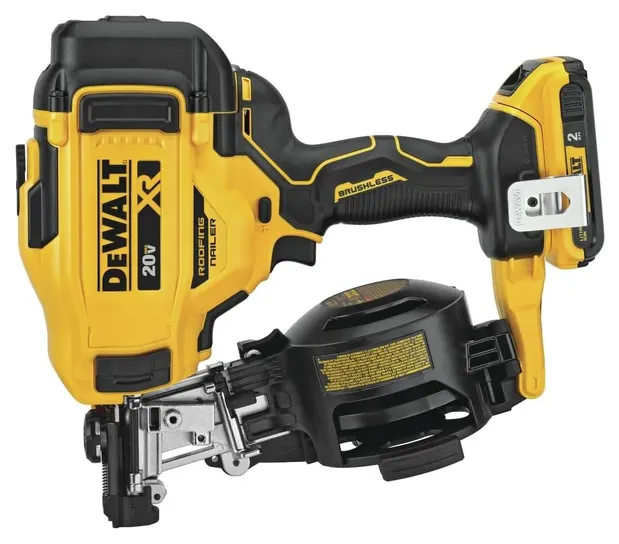
From the manual
- Bump fire is the only firing mode listed; there is no single-shot setting. p. 9
- If it stalls, flip the stall-release lever; the tool stays disabled until you pull the battery and put it back. p. 12
- Don't use it in wet conditions, and don't leave the tool or battery anywhere that reaches 104 F, such as a summer shed. pp. 6, 9
- Three years on the tool and two on the battery. p. 14
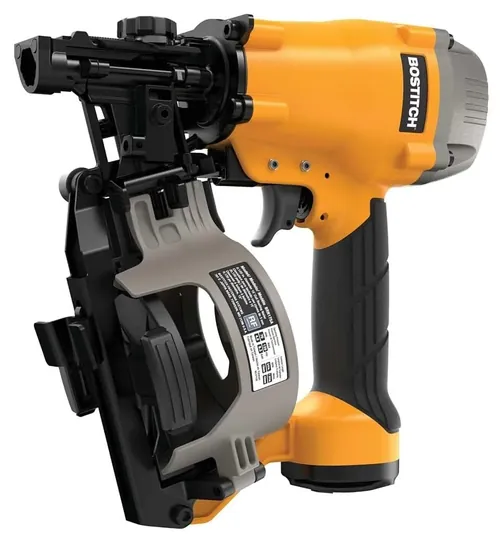
From the manual
- The manual describes a contact trigger: press the nose then pull for one nail, or hold the trigger and bump to fire fast. pp. 2, 6
- Set the nail platform to the nail length: lowest for 1-1/2 to 1-3/4 inch, center for 1-1/4, upper for 3/4 to 1. p. 5
- The depth wheel next to the trigger clicks every quarter turn; Bostitch says to run the lowest air pressure that drives nails consistently. p. 6
- Seven-year warranty, one year in production use; driver blades, bumpers, O-rings and pistons count as wear parts. p. 2
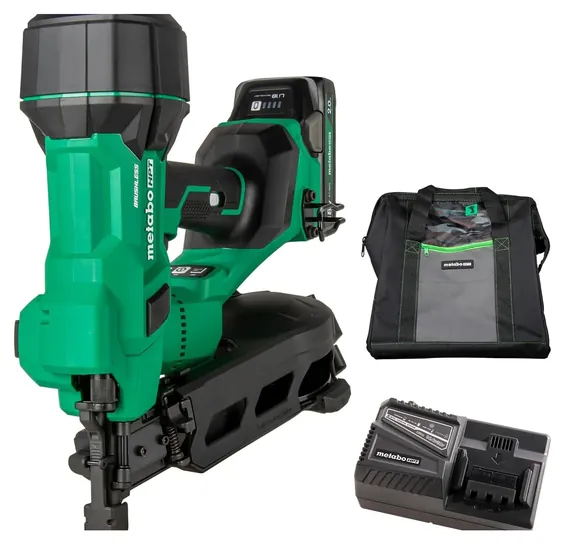
From the manual
- It always powers up in single-shot mode; one press of the mode switch changes it to bump fire. p. 15
- The operating range is 32 to 104 F, and it may not work outside it, which matters for winter repairs. p. 5
- The 9.5-pound weight in the spec table includes the battery. p. 10
- Unauthorized parts, accessories or nails can void the warranty. p. 6
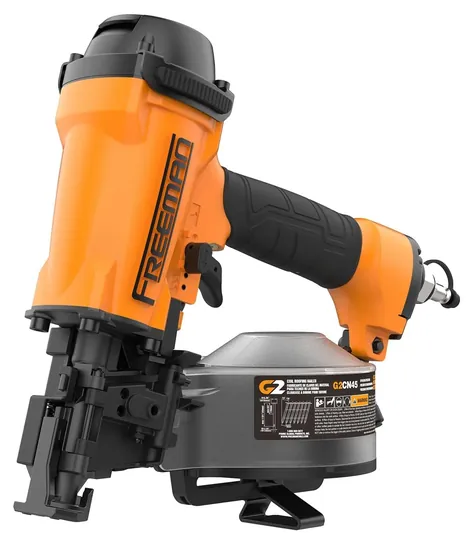
From the manual
- Connect the air before loading nails: Freeman warns the gun may fire when it is first hooked up. p. 9
- Warranty registration is required; wear parts such as driver blades, bumpers and O-rings get 90 days, not seven years. pp. 6-7
- Skipping oil voids the warranty; Freeman asks for 2 to 3 drops in the air inlet. p. 13
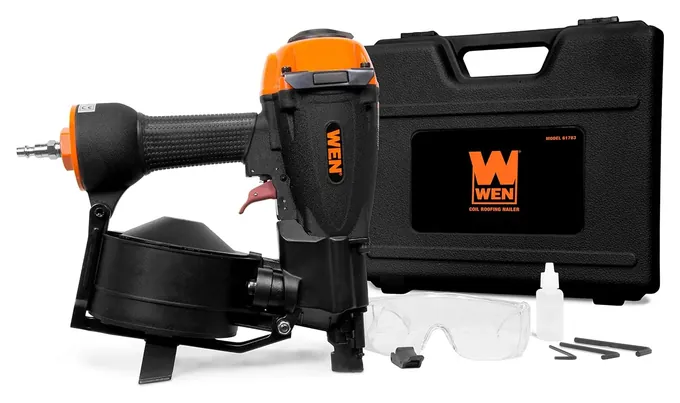
From the manual
- The red bump-fire trigger comes fitted, and a black single-shot trigger is in the box; swapping means pulling the trigger pin. pp. 7, 11
- Without an in-line oiler, put 4 to 5 drops of oil in the air inlet each workday or after an hour of steady use. p. 14
- WEN lists 0.1 cubic feet of air per shot at 100 psi, so size the compressor with that in mind. p. 2
- The manual gives two years for home use and 90 days for professional use; WEN's product page says one year. p. 18
Editor's Notes
November 17, 2026, by Ezvid Wiki Editors:
We dropped the Senco RoofPro 445XP and the Freeman PCN450 after both went out of stock; Freeman's second-generation G2CN45 takes the budget slot, and the Bostitch BRN175A joins as a hard-wearing air gun. The top five are unchanged. We then read the manuals for all ten guns, added a spec table and a section on why the RN46-1 leads, and corrected the BRN175A's warranty and trigger type, the Makita's last-nail magnet and the Max air-use figure.
November 16, 2026, by Ezvid Wiki Editors:
We dropped the Senco RoofPro 445XP and the Freeman PCN450 after both went out of stock with no seller left to link to. Freeman's second-generation G2CN45 takes the budget slot with the same seven-year warranty and a switchable trigger, and the Bostitch BRN175A joins as an air gun whose firing mode changes with a dial. The top five picks are unchanged.
October 22, 2026, by Ezvid Wiki Editors:
The Bostitch RN46-1 stays on top: it is light, long proven on roofs, and backed by a seven-year warranty. The big change is cordless. Battery guns from Milwaukee, DeWalt and Metabo HPT now handle real shingling on repairs and small jobs, so three join the list, led by the Milwaukee M18 FUEL 2909-20 with its choice of single-shot or bump firing. The DeWalt DCN45RND1 moves up from special honors.
We dropped the DeWalt DW45RN, which DeWalt discontinued, the Milwaukee 7220-20 and Ridgid R175RNA because of availability concerns, and the 3Plus HCN45SP, a little-known brand with no independent reviews. The Freeman PCN450 takes the budget slot, the WEN 61783 stays for occasional jobs, and the Senco entry is now the Senco RoofPro 445XP.
Nobody runs lab tests on roofing nailers, so the deciding evidence was what roofers say they use, the job-site reviews at Pro Tool Reviews, each maker's trigger and warranty terms, and NIOSH's data on bump-fire injuries.
Earlier notes
May 13, 2021, by Will Rhoda:
We replaced the Hitachi NV45AB2 with the Metabo HPT NV45AB2, which is essentially a rebranded version of the same tool, and swapped out the Wen 61782 with its logical successor: the Wen 61783.
Neither the Craftsman 18180 nor the Porter-Cable RN175B were available during this update, so we were happy to switch them out for tools from company’s with better reputations, believing that our list already had enough mid-grade options — like the 3Plus HCN45SP and our pick from Wen.
When considering options from DeWalt, we favored the DeWalt DW45RN over the company’s battery-powered DCN45RND1, even though we know that dragging an air compressor to every job site is a drag, because we just didn’t think it could keep up with the pros.
It can purportedly fire 500 nails per charge with a two-amp-hour battery (yes, going bigger could be an option... if you're also willing to go heavier), but anybody who has heard a crew really going to town when they’re trying to get a roof done on a Friday afternoon knows: 500 isn’t a lot. So, while we’re still a big fan of DeWalt's power tools, we chose to rank their pneumatic gun instead, though the 20-volt option could still be a great asset for small jobs and service calls.
We also added the Makita AN454 to our list, which struck as a good all-around pick, offering a selectable trigger, a light unit weight of 5.2 pounds and a convenient belt hook to hang the gun off your tool belt when you aren’t nailing. [2026 update: Makita's AN454 manual says not to hang the hook from a waist belt, because a dropped nailer can misfire; the hook is for hanging the gun up briefly.]
Roofing nailers are great for roofing, but that’s about all they’re great for. For other applications, check out our lists of framing nailers, brad nailers, finish nailers and pinners.
January 22, 2020, by Alexander Rennie:
During this round of updates, we replaced the Grip-Rite GRTCR175 with the 3PLUS HCN45SP. This new entry is half the price of the Grip-Rite GRTCR175, without the quality issues.
When you're up on a roof for hours, you don't have workbenches or even a floor to set your tool on, so you'll be holding it for the majority of the time you're up there. This means you want your nailer to be as light as possible, especially considering the added weight of the large coil magazines that roofing jobs require. Having a large number of nails in your magazine may be convenient, but it also adds to the overall weight of the tool. We kept that in mind while updating this list, and made sure none of the options were heavier than necessary.
Keep in mind that these options are specifically suited for use while roofing or siding. If you're looking for something for more general use, take a look at a framing nailer, or for projects that need a little more precision, a brad nailer could be more up your alley.
Air Or Battery: Which Kind Fits The Job
Cordless guns win on small jobs, repairs and steep roofs where a hose is a trip hazard, and that is the work their makers aim them at.
Air-powered coil nailers are still the standard on roofing crews. The air guns here weigh about 4.5 to 6 pounds bare, while the cordless models run 6.8 to 8.6 pounds before the battery goes on (see the table), and that difference adds up over a day of bending over shingles. Air guns also have fewer parts to fail and cost less to buy.
They do need a compressor and hose, though not a big one. Bostitch says the RN46-1 needs 3.9 cubic feet of air a minute to drive 100 nails a minute at 80 psi, and half that at 50 nails a minute; Max lists 0.046 cubic feet per shot at 90 psi for the SuperRoofer. Most of these guns run between 70 and 120 psi. Check a compressor's cfm rating at 90 psi against those figures; a crew running several guns needs a bigger one.
Cordless guns win on small jobs, repairs and steep roofs where a hose is a trip hazard, and that is the work their makers aim them at. Milwaukee rates its M18 FUEL 2909-20 at up to 6 nails per second (Milwaukee), and DeWalt says a 2 Ah battery drives about 500 nails, roughly one square of shingles (DeWalt). Plan on a spare battery for anything bigger than a patch.
Nails, Depth And The Shingle Guide
Every gun on this list drives 0.120-inch (11-gauge) wire-collated coil roofing nails up to 1-3/4 inches long, from a canister of about 120. Most start at 3/4 inch; the two Metabo HPT models start at 7/8 inch and take 16-degree coils, per Metabo HPT, while most of the others take 15-degree coils. Use galvanized nails long enough to reach through the sheathing or at least 3/4 inch into it, which is what the International Residential Code asks for asphalt shingles. Ridge caps and second layers need the longer sizes.
Set the depth on a scrap of the shingle you're installing. GAF's shingle instructions say nails must sit flush: an overdriven nail damages the shingle, and a raised one keeps it from sealing and can back out. Every pick has a depth adjustment you change without tools. The shingle guide, a sliding bar on the nose, sets the exposure so each course lines up.
A roofing nailer is not a stapler, and it isn't a framing or masonry tool. Some double as siding guns: the Milwaukee and Metabo HPT cordless models come with a vinyl siding tip, and Max lists siding among the SuperRoofer's jobs. For fastening into concrete, see our nail guns for concrete.
Triggers, Recoil And Roof Safety
Nail guns fire in one of two ways. A sequential trigger fires one nail each time you press the nose down and then pull the trigger. A contact, or bump, trigger fires whenever the nose touches the roof while you hold the trigger, which is fast but can drive a second nail if the gun bounces. Research cited by OSHA puts the injury risk with a contact trigger at about twice that of a single-shot sequential trigger, and NIOSH recommends full sequential triggers, though bump firing remains common on roofs.
Makers handle this differently. The Bostitch RN46-1 fires in bump mode, and its single-shot twin is a separate model, the RN46-2. The Metabo HPT NV45AB2 and Max SuperRoofer CN445R3 ship with contact triggers and sell single-shot kits, the DeWalt DCN45RND1 fires in bump mode only, the Bostitch BRN175A's manual describes a contact trigger, and WEN puts both triggers in the box. The Milwaukee M18 FUEL 2909-20, Makita AN454, Metabo HPT NV1845DA and Freeman G2CN45 switch between modes.
Wear safety glasses rated ANSI Z87.1, keep your finger off the trigger when you carry or climb, and disconnect the air or remove the battery before clearing a jam. On a roof, a fall is the bigger danger: use a harness and anchor that meet OSHA's fall protection rules.
How we researched this
We compared 16 coil roofing nailers and narrowed them to 10. We read the makers' manuals for all ten: Bostitch's RN46 and BRN175A manuals, Metabo HPT's NV45AB2 and NV1845DA instruction manuals, Max's CN445R3 operating manual, and the Makita AN454, DeWalt DCN45RN, Milwaukee 2909-20, Freeman G2CN45 and WEN 61783 manuals, along with each maker's warranty terms. Pro Tool Reviews' job-site reviews of the three cordless guns and the nail gun safety guidance from NIOSH and OSHA shaped the trigger advice. A search of CPSC recalls on November 16, 2026 found none for any of the ten; the closest was a 2012 recall of Ridgid's R175RNE coil roofing nailer.
Sources (22)
- Metabo HPT: NV45AB2 coil roofing nailer
- Milwaukee: M18 FUEL coil roofing nailer 2909-20
- DeWalt: DCN45RND1 20V Max coil roofing nailer kit
- DeWalt Canada: DW45RN
- Pro Tool Reviews: Metabo HPT cordless coil roofing nailer
- Pro Tool Reviews: Milwaukee M18 FUEL coil roofing nailer
- Pro Tool Reviews: DeWalt 20V cordless roofing nailer
- ServiceTitan: best roofing nailers
- Bob Vila: best roofing nailers
- Roofr: nail guns for roofers
- JobNimbus: best roofing nailers
- NIOSH: nail gun safety
- OSHA: fall protection
- International Residential Code, chapter 9
- CPSC: Ridgid pneumatic nailers recalled
- OSHA: nail gun safety
- GAF: Timberline shingle application instructions
- CPSC: nail gun recalls
- Makita: warranty
- Max: nailer and compressor warranty
- Freeman: G2CN45 coil roofing nailer
- WEN: 61783 coil roofing nailer
Frequently asked questions
What nail gun do most roofers use?
A pneumatic coil roofing nailer. Air guns such as the Bostitch RN46-1 and Metabo HPT NV45AB2 weigh under 6 pounds and need little more than daily oil, and Metabo HPT says Builder and Developer magazine named the NV45AB2 its Pro Preferred nailer every year from 2014 to 2025.
Milwaukee or DeWalt cordless roofing nailer?
The Milwaukee M18 FUEL 2909-20 is rated at up to six nails a second and offers both single-shot and bump firing, but it is sold without a battery. The DeWalt DCN45RND1 kit includes a battery and charger, and it fires in bump mode only.
Metabo HPT or Bostitch?
Both are proven air guns that ship in bump-fire mode. The Bostitch RN46-1 is lighter, 4.8 pounds to 5.7, and carries a seven-year warranty to Metabo HPT's five. The Metabo HPT NV45AB2 is rated at up to 10 nails a second and sells a single-shot kit; Bostitch sells single-shot as a separate model, the RN46-2.
What size compressor do I need for a roofing nailer?
Look at the compressor's cfm rating at 90 psi rather than its tank size. Bostitch says the RN46-1 needs 3.9 cfm to fire 100 nails a minute at 80 psi, and half that at 50 a minute; Makita asks for at least 2.2 cfm at 90 psi. A small compressor can keep up with a homeowner nailing at a steady pace, and crews running more than one gun need a larger one.
What nails does a roofing nailer use?
Coil roofing nails, 11 gauge, wire-collated at 15 or 16 degrees depending on the gun, usually 3/4 to 1-3/4 inches long. Galvanized nails are standard for asphalt shingles.
Can a roofing nailer shoot staples?
No. Roofing staplers are separate tools, and many shingle makers and building codes call for nails on asphalt shingles.